New Delhi | May 26,2026 | SKY LINK TIMES
12 Years of Modi Government:
India on Monday marked 12 years since Narendra Modi first took oath as the country’s 15th Prime Minister, a political moment widely viewed as the beginning of a new phase in Indian governance, economic policy, national security and global diplomacy.
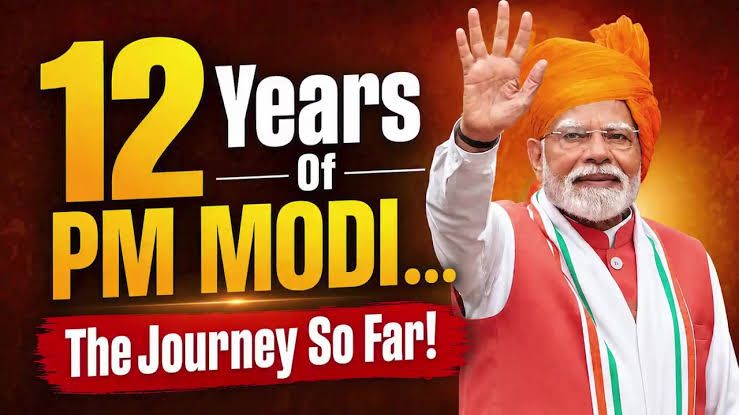
On May 26, 2014, Narendra Modi led the Bharatiya Janata Party (BJP) to a historic victory in the Lok Sabha elections, winning 282 seats and securing a full majority in the 543-member House. It was the first time in nearly three decades that a single political party crossed the majority mark on its own.
Table of Contents
Historic Political Shift in 2014
The 2014 mandate marked a major turning point in Indian politics after years of coalition governments between 1989 and 2014.
During that period, alliances such as the United Front, National Democratic Alliance (NDA), and United Progressive Alliance (UPA) governed the country through coalition arrangements. The BJP’s clear majority in 2014 enabled a single-party-led government with greater decision-making authority while still maintaining coalition ties under the NDA umbrella, which together held 336 seats.
The swearing-in ceremony at Rashtrapati Bhavan also drew global attention as leaders from all SAARC nations attended the event, signalling a new direction in India’s regional diplomacy.
Over 4,000 guests, including diplomats, political leaders, industrialists and cultural personalities, attended the ceremony where then-President Pranab Mukherjee administered the oath of office and secrecy to Modi and his Council of Ministers.
Economic Reforms and Make in India Push
Since 2014, the Modi government has launched several flagship initiatives aimed at transforming India’s economy, governance structure and infrastructure development.
Among the key initiatives was the “Make in India” campaign, introduced to boost domestic manufacturing, attract foreign investment, simplify regulations and develop industrial corridors and smart cities.
The government also accelerated digital governance initiatives, expanded direct benefit transfers, promoted financial inclusion through schemes such as Jan Dhan Yojana, and pushed infrastructure expansion across roads, railways, airports and ports.
Supporters of the government credit these reforms with strengthening India’s economic foundations and improving service delivery mechanisms.
Also Read:https://skylinktimes.in/rubio-meets-pm-modi-and-extends-white-house-invite/
Stronger National Security and Foreign Policy
The Modi government’s tenure has also been marked by a more assertive national security approach.
The 2016 surgical strikes following the Uri terror attack and the 2019 Balakot airstrike after the Pulwama attack were viewed as major shifts in India’s military response strategy against cross-border terrorism.
On the diplomatic front, India pursued an “India-first” foreign policy approach while strengthening strategic partnerships with countries including the United States, Japan, Russia and European nations.
Initiatives such as the Act East Policy and the International Solar Alliance further expanded India’s role in regional and global affairs.
Digital Governance and Welfare Expansion
The last 12 years have also witnessed major changes in political communication, welfare delivery and governance models.
Large-scale welfare programmes, digital platforms for public services, expansion of UPI-based digital payments and increasing use of technology in governance have reshaped public administration in India.
Political analysts note that the period since 2014 has been characterised by centralised decision-making, welfare-driven governance, muscular nationalism and ambitious economic goals aimed at positioning India among the world’s leading economies.
Twelve years after Narendra Modi first took oath at Rashtrapati Bhavan, the political and policy changes initiated during this period continue to shape India’s governance and global positioning.
For More Info Stay Tuned: https://skylinktimes.in