Washington | November 13, 2025 | SKY LINK TIMES |
S. Jaishankar at G7:
External Affairs Minister S. Jaishankar represented India at the G7 Foreign Ministers’ Meetings in Niagara, Canada, where he outlined India’s key priorities on energy security, critical minerals, and maritime stability, while also engaging in a flurry of bilateral discussions with global counterparts.
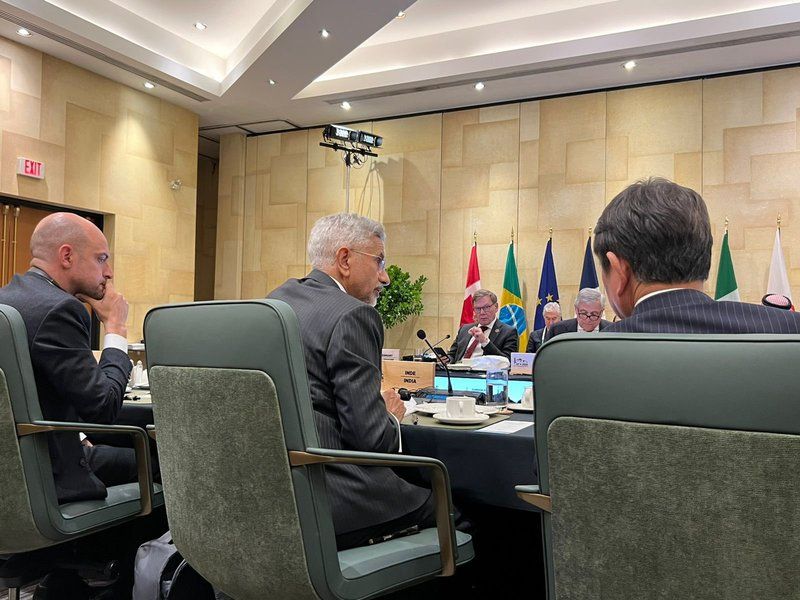
The G7 meetings, held this week, brought together foreign ministers and senior representatives from major economies to discuss pressing global challenges, from energy transitions and supply chains to maritime cooperation and geopolitical security.
Table of Contents
India’s Call for Energy Resilience and Global Coordination
In the outreach session on energy security and critical minerals, Jaishankar presented India’s perspective on the importance of building resilient and predictable global supply chains.
> “Spoke about the need on both issues to mitigate dependence, strengthen predictability and build resilience. Greater international cooperation is the only way forward,” he posted on X (formerly Twitter).
The minister noted that global energy markets were witnessing “unpredictability and constrictions,” adding that policy coordination and implementation among nations were essential for stability.
> “Implementation is the key, and India is open to working constructively with international partners,” he said.
India as a Maritime ‘First Responder’ in the Indo-Pacific
At a separate session on maritime security, Jaishankar highlighted India’s growing role as a “first responder in the maritime domain” and emphasized Humanitarian Assistance and Disaster Relief (HADR) cooperation through joint exercises and logistics partnerships.
He introduced India’s MAHASAGAR outlook, which aligns with New Delhi’s Indo-Pacific vision and its port-led development initiatives at home.
Listing India’s recommendations, Jaishankar stressed the need for trusted and diversified maritime links, protection of critical undersea infrastructure, and deeper cooperation against maritime crimes such as piracy, smuggling, and illegal fishing.
> “Maritime trade is central to global prosperity. Resilient ports and secure waterways are vital to our collective progress. The UNCLOS must be upheld,” he said.
Also Read:https://skylinktimes.in/india-us-ties-deepen/
Engagements with Global Leaders
On the sidelines of the G7, Jaishankar met with several leaders, including his counterparts from the EU, Ukraine, Saudi Arabia, and the United States.
During his meeting with U.S. Secretary of State Marco Rubio, Jaishankar discussed trade, supply chains, and the Indo-Pacific, while Rubio expressed condolences over the recent Delhi blast.
He also met Ukraine’s Foreign Minister Andrii Sybiha, who briefed him on the current battlefield situation and peace efforts.
Jaishankar discussed the India–EU Strategic Partnership with EU High Representative Kaja Kallas and reviewed regional and energy cooperation with Saudi Foreign Minister Prince Faisal bin Farhan.
On Tuesday, Jaishankar had also engaged with ministers from Canada, Mexico, France, Brazil, South Africa, the UK, and Germany, underscoring India’s active role in shaping global dialogue.
Strengthening India’s Global Diplomatic Footprint
Through his extensive participation, Jaishankar reinforced India’s position as a constructive global stakeholder, emphasizing energy transition partnerships, maritime resilience, and inclusive international cooperation.
The G7 outreach showcased India’s evolving diplomatic influence, bridging the gap between the Global North and South while addressing shared challenges in trade, technology, and sustainability.
For More Info Stay Tuned:https://skylinktimes.in