New Delhi | December 19, 2025 | SKY LINK TIMES
SHANTI Bill 2025:
Parliament has passed the Sustainable Harnessing and Advancement of Nuclear Energy for Transforming India SHANTI Bill 2025, marking a major policy shift aimed at strengthening India’s nuclear energy ecosystem and advancing long-term energy security. The Bill aligns with India’s clean energy vision, including the target of 100 GW nuclear capacity by 2047 and net-zero emissions by 2070.
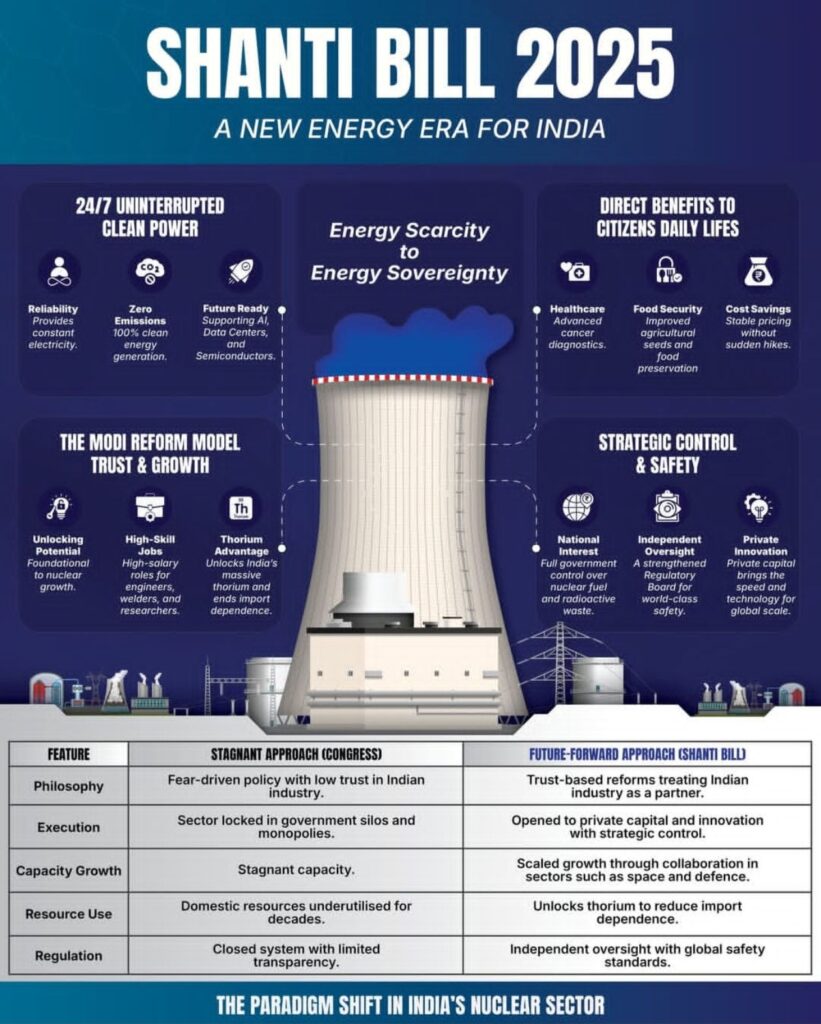
Introduced amid rising power demand, climate commitments and the need for round-the-clock clean energy, the legislation seeks to modernise India’s nuclear governance while maintaining strict safety and strategic controls.
Table of Contents
Why the SHANTI Bill 2025 Matters
India’s energy needs are growing rapidly due to urbanisation, industrial expansion, data centres and electric mobility. While renewables like solar and wind are expanding, they remain intermittent. Nuclear energy provides 24/7 reliable, low-carbon base-load power, making it crucial for energy stability and sovereignty.
According to the government, the SHANTI Bill addresses long-standing bottlenecks such as limited capacity expansion, high capital costs and long project gestation periods.
Key Provisions of the SHANTI Bill
1. Opening the Nuclear Sector to Private Participation
For the first time, the Bill enables responsible private and joint venture participation in nuclear power generation under clearly defined conditions. This move is expected to mobilise capital, enhance efficiency and accelerate capacity addition—similar to reforms seen earlier in the space sector.
However, strategic areas remain under government control, including:
Uranium mining beyond defined thresholds
Spent nuclear fuel management
Control over fissile material, heavy water and source material
2. Stronger Safety and Regulatory Oversight
The Bill grants statutory status to the Atomic Energy Regulatory Board (AERB), strengthening its authority and independence. Safety norms remain unchanged, following the principle of “safety first, production next” enshrined in the Atomic Energy Act, 1962.
Safety measures include:
Quarterly inspections during construction
Biannual inspections during operation
Five-yearly licence renewals
Oversight aligned with International Atomic Energy Agency (IAEA) standards
3. Revised Civil Liability Framework
The SHANTI Bill rationalises provisions of the Civil Liability for Nuclear Damage Act, explicitly recognising environmental and economic damage within the definition of nuclear harm. It also proposes new institutional mechanisms such as:
Atomic Energy Redressal Advisory Council
Nuclear Damage Claims Commission
Designated Claims Commissioners
Beyond Power: Wider Applications of Nuclear Technology
The Bill recognises nuclear energy’s role beyond electricity generation, including:
Cancer diagnosis and radiotherapy
Agricultural applications
Industrial and research uses
Dedicated investments in Small Modular Reactors (SMRs) and nuclear research are expected to boost innovation and domestic manufacturing.
Also Read:https://skylinktimes.in/indian-scientists-create-glowcas9/
Balancing Growth, Safety and Strategic Control
Union Minister Dr. Jitendra Singh stated in Parliament that India’s nuclear facilities are located away from major seismic fault zones and radiation levels remain far below global safety limits. The Bill, he said, balances expansion with accountability, public interest and national security.
Conclusion
The SHANTI Bill 2025 represents a paradigm shift in India’s nuclear policy—from a closed, state-only model to a trust-based, future-forward approach. If implemented effectively, it could play a pivotal role in ensuring energy security, reducing carbon emissions and positioning India as a global leader in clean nuclear energy.
For More Info Stay Tuned: https://skylinktimes.in