Washington | May 22,2026 | SKY LINK TIMES
MQ-9 Reaper Drones Lead US Operations Against Iran:
The US Air Force’s MQ-9 Reaper drones have emerged as one of the most heavily used and strategically important platforms during recent operations linked to Iran, senior Pentagon officials told lawmakers this week. The unmanned aircraft reportedly played a major role in combat missions conducted under Operation Epic Fury, highlighting the growing dependence of the US military on drone warfare and autonomous systems.
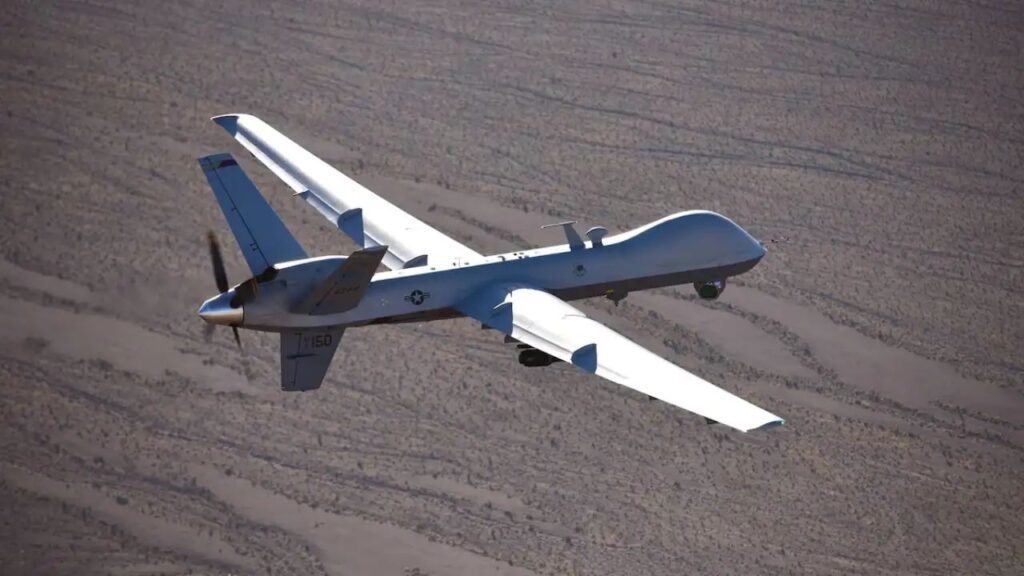
Speaking before Congressional committees, Air Force Chief of Staff General Kenneth Wilsbach described the MQ-9 as the “most valuable player” during the operations.
Table of Contents
MQ-9 Reaper Played Major Role in Operation Epic Fury
During a hearing of the House Armed Services Committee, General Wilsbach said the MQ-9 Reaper carried out a significant number of strikes during Operation Epic Fury.
“For Epic Fury, perhaps maybe the most valuable player was unmanned and that’s the MQ-9,” Wilsbach told lawmakers.
He added that the number of strikes carried out by the drone fleet remains classified, but noted that no other military platform came close to matching the MQ-9’s operational contribution.
The MQ-9 Reaper is a remotely piloted unmanned combat aerial vehicle widely used for intelligence gathering, surveillance and precision strikes. Pentagon officials said the platform provided “a lot of utility” while significantly reducing risks to pilots and crew members.
Pentagon Defends Future Drone Warfare Plans
The comments came as the Department of the Air Force defended its proposed FY2027 budget before both the House and Senate Armed Services Committees.
The hearings focused heavily on the future of unmanned warfare, autonomous systems and the balance between costly next-generation fighter jets and lower-cost drone technology.
Air Force Secretary Troy Meink confirmed that the MQ-9 fleet would not be retired despite ongoing modernisation plans.
“We are not divesting the MQ-9,” Meink told lawmakers.
He explained that the Air Force is instead exploring successor systems that could operate alongside manned fighter aircraft and autonomous combat platforms.
According to Meink, the next generation of unmanned systems will likely consist of multiple interconnected platforms rather than a single replacement aircraft.
Also Read:https://skylinktimes.in/mission-drishti-launch/
Collaborative Combat Aircraft Gain Importance
General Wilsbach also highlighted the development of Collaborative Combat Aircraft (CCA), autonomous systems designed to operate alongside advanced fighter jets such as the F-47, F-22 and F-35.
He said these systems are already being tested and have shown promising operational capabilities.
“The autonomous systems are working. We’re learning from it and adjusting as we go,” Wilsbach said during the Senate hearing.
The Pentagon’s proposed FY2027 budget reportedly includes nearly $1.4 billion for CCA development as part of a broader push toward artificial intelligence, autonomous combat systems and advanced battlefield management technologies.
Growing Debate Over Manned vs Unmanned Combat
Congressional leaders repeatedly questioned Air Force officials over the future balance between traditional manned fighter aircraft and remotely operated combat systems.
House Armed Services Committee Chairman Mike D. Rogers urged the Air Force to accelerate the transition toward autonomous combat aircraft in order to reduce operational risks and lower military costs.
Recent reports also indicate that the US Air Force’s MQ-9 fleet has faced losses during operations linked to Iran, underscoring both the growing importance and vulnerability of drone warfare in modern conflicts.
For More Info Stay Tuned: https://skylinktimes.in