New Delhi | February 2, 2026 | SKY LINK TIMES
Budget 2026:
In a significant push towards strengthening India’s scientific and space research capabilities, the Union government on Sunday announced plans to promote astrophysics and astronomy by setting up and upgrading four major telescope infrastructure facilities across the country.
Union Finance Minister Nirmala Sitharaman made the announcement while presenting her ninth consecutive Union Budget in Parliament, underlining the Centre’s commitment to advancing frontier research and inspiring future scientists.
Table of Contents
Four Key Telescope Facilities Identified
The Finance Minister said the new investments aim to expand India’s observational capabilities, support cutting-edge astronomical research, and encourage young minds to pursue careers in science.
The four facilities identified under Budget 2026 include:
• National Large Solar Telescope (NLST)
• National Large Optical Infrared Telescope (NLOT)
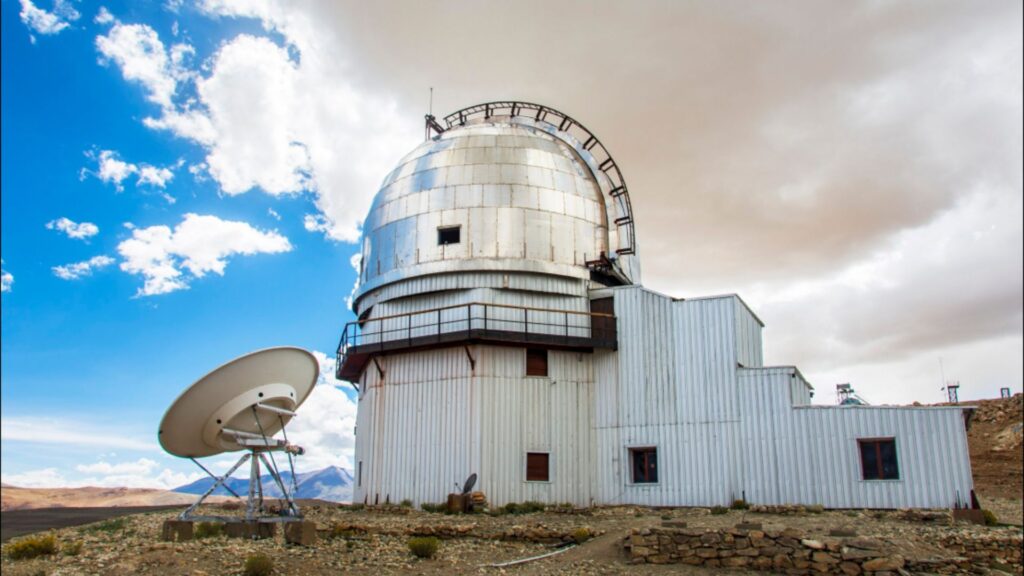
• Himalayan Chandra Telescope
• COSMOS 2 Planetarium
National Large Solar Telescope (NLST)
The NLOT is proposed as a 10–12 metre class ground-based observatory, envisioned as India’s premier optical and infrared telescope.
Located at the Indian Astronomical Observatory in Hanle, Ladakh, the facility will significantly strengthen India’s ability to observe faint and distant celestial objects, including exoplanets, nebulae, and distant galaxies. The project is part of a broader national effort to upgrade astronomical infrastructure alongside the NLST.
Himalayan Chandra Telescope Upgrade
The Himalayan Chandra Telescope, also located in Ladakh, will be upgraded to enhance its sensitivity and instrumentation.
Situated in a region known for exceptional atmospheric conditions, the upgrade will allow astronomers to conduct more precise and deeper observations, supporting advanced research across multiple areas of astrophysics.
Also Read:https://skylinktimes.in/drdo-unveils-10-hypersonic-anti-ship-missile/
COSMOS 2 Planetarium for Public Outreach
The COSMOS 2 Planetarium will be developed as a modern public outreach and education centre, aimed at popularising astronomy and space science among students and the general public.
The initiative is expected to play a key role in science communication and awareness, nurturing curiosity and interest in space research from an early age.
Strengthening India’s Global Space Leadership
According to the government, these investments are expected to reinforce India’s position as a global leader in space and astronomical research, complementing the country’s growing achievements in space exploration and scientific innovation.
For More Info Stay Tuned: https://skylinktimes.in