SKY LINK TIMES | Special Report
The Lumding–Silchar Broad Gauge Railway Line, spanning 434 kilometres, stands today as one of the most strategically significant rail infrastructure projects in the North-Eastern Region, serving as a vital connectivity corridor for southern Assam’s Barak Valley and the hilly states of Tripura, Manipur, and Mizoram.
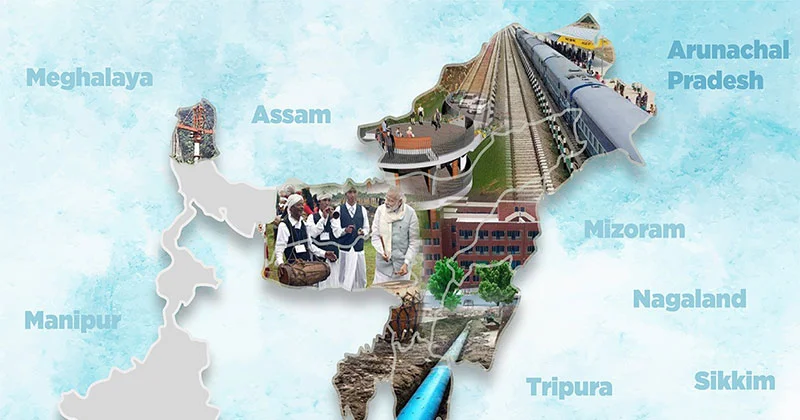
Sanctioned in 1996–97 and declared a National Project in 2004, the gauge conversion initiative was designed to strengthen the national rail network in the Northeast in line with the development vision for the Ashta Lakshmi States. The project was completed at a total cost of ₹8,359.20 crore, achieving 100% physical progress, and was fully commissioned on March 1, 2017.
Two-Phase Implementation
The project was executed in two distinct phases:
- Phase I: Lumding–Silchar section (210 km)
- Phase II: Badarpur–Kumarghat, Baraigram–Dullabcherra, and Silchar–Jiribam sections (224 km)
Despite its strategic importance, the project faced prolonged delays in the early years due to fund constraints, difficult terrain, heavy rainfall, limited road access, and insurgency-related disruptions between 2006 and 2009, which even required deployment of the Territorial Army. Normal construction activity resumed only after the security situation stabilised post-2009.
PRAGATI Review and Acceleration of Lumding–Silchar Rail Project
The project came under focused national attention when it was reviewed by the Hon’ble Prime Minister under the PRAGATI mechanism on March 25, 2015. At the time, progress was minimal. Following the Prime Minister’s directions, enhanced inter-agency coordination, strict monitoring, and time-bound execution were implemented, leading to rapid acceleration.
A major breakthrough came with a mega block operation from October 1, 2014, involving round-the-clock construction at multiple locations. The Lumding–Silchar section (Phase I) was opened for goods traffic on March 27, 2015, followed by passenger services shortly thereafter. The first Broad Gauge locomotive reached New Haflong on January 12, 2015, and was extended up to Silchar on March 13, 2015. Full commercial operations began on March 31, 2015, marking a historic milestone.
Engineering Feat in Difficult Terrain
The alignment passes through extremely challenging hill terrain between Lumding and Badarpur, characterised by steep gradients, unstable geology, frequent landslides, and heavy rainfall. The project includes 21 tunnels spanning 12.86 km, with the longest being Tunnel No. 10 (2.8 km), and major engineering structures such as the Dayang Bridge near Haflong.
Despite severe geo-technical and climatic challenges, the project was executed to high technical standards through sustained institutional effort by the Northeast Frontier Railway, supported by district administrations and multiple agencies.
Socio-Economic Impact
The Lumding–Silchar corridor serves as a lifeline for approximately 76 lakh people, enabling safe and reliable movement of foodgrains, fertilisers, petroleum products, construction materials, and other essential commodities. It has also significantly reduced dependence on road transport and improved freight reliability.
ALSO READ: https://skylinktimes.in/nia-probe-bangladesh-linked-jihadi-funding-network/
The estimated annual freight value moving through the corridor is around ₹500 crore, including forest-based products, bamboo, handicrafts, and horticultural produce. The improved connectivity has enhanced access to education, healthcare, employment, and major centres such as Agartala, Imphal, Aizawl, Guwahati, and Delhi.
A Transformative Milestone
Completed in its entirety on March 1, 2017, the Lumding–Silchar Broad Gauge Railway Line stands as a transformative infrastructure milestone for the Northeast. The project exemplifies the impact of high-level monitoring under PRAGATI, coordinated execution, and sustained commitment, reaffirming the Government of India’s resolve to promote inclusive development and national integration across the North-Eastern Region.
For More Info Stay Tuned: https://skylinktimes.in