Shanghai/Beijing, November 6, 2026: China has become the first country to approve an invasive brain-computer interface (BCI) for commercial medical use. On March 13, 2026, the National Medical Products Administration cleared NEO, a device developed by Shanghai-based Neuracle Technology with researchers from Tsinghua University.
NEO, a coin-sized implant, lets people with spinal cord injuries control a robotic glove with their thoughts
How it works
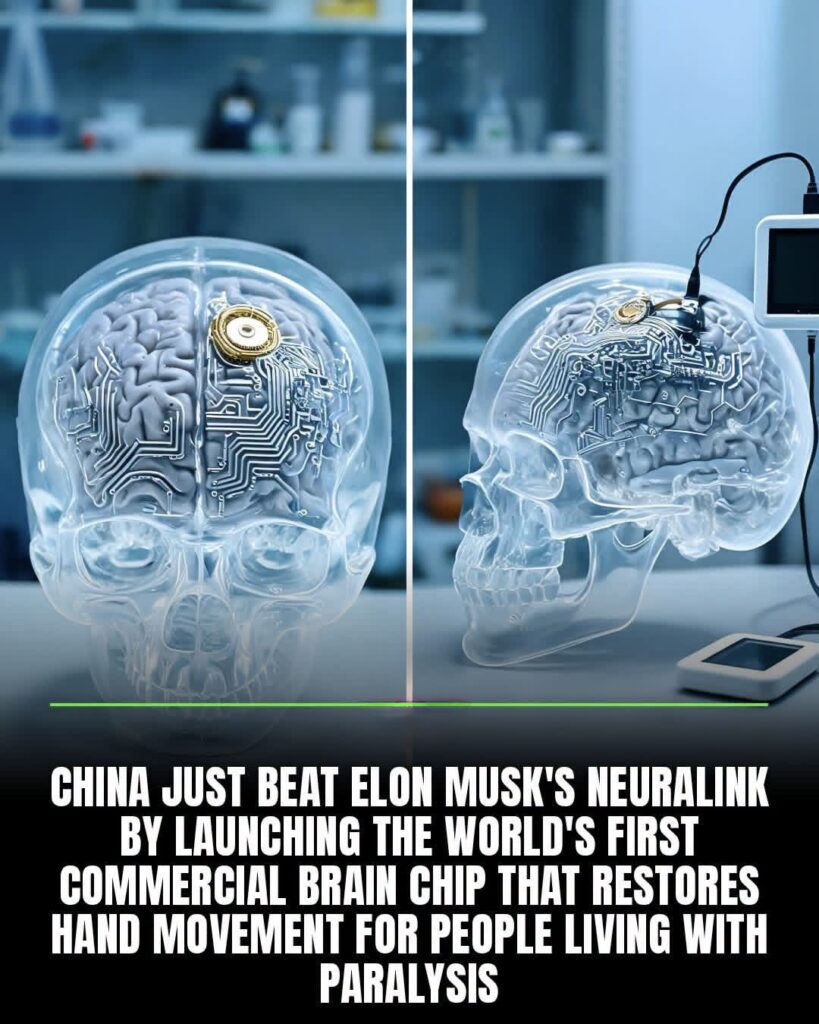
NEO is a coin-sized wireless implant placed beneath the skull. Eight electrodes rest on the dura mater, the brain’s protective membrane, above the region that controls movement. Unlike some rival implants, it does not penetrate brain tissue, which is intended to lower surgical risk.
When a patient imagines moving their hand, the implant picks up the related neural signals and sends them wirelessly to an external computer. The computer decodes them in real time and drives a soft pneumatic glove on the patient’s paralyzed hand. In trials, participants used the system to grasp objects, pick up cups and drink water.
Evidence and limits
The approval rests on a clinical study of 36 implant procedures, with 18 months of follow-up. The clearance is narrow, covering patients with severe spinal cord injuries who have lost hand function. NEO supports grasping and basic finger movement. It does not restore fine dexterity or sensation, and it is not a cure for paralysis. Patients still need specialized surgery and rehabilitation.
Analysts also caution that being first to market does not mean China leads in the underlying technology. Penetrating implants such as Neuralink’s can record richer signals but remain in clinical trials. Independent, peer-reviewed results and post-market safety data will show whether NEO delivers lasting benefit.
Policy backing
Within days of the approval, China assigned NEO a code in its national health insurance system, a step toward reimbursement. Brain-computer interfaces are also named among the future industries in the country’s latest five-year plan.
What comes next
For patients, the key questions are access, cost and long-term safety. For regulators worldwide, NEO adds urgency to unresolved issues such as who owns the neural data these devices collect.
Sources: reporting from MIT Technology Review, FierceBiotech and Medical Device Network, and analysis from Paradromics.