Washington | April 25,2026 | SKY LINK TIMES
NASA’s Bold 3-Step Plan:
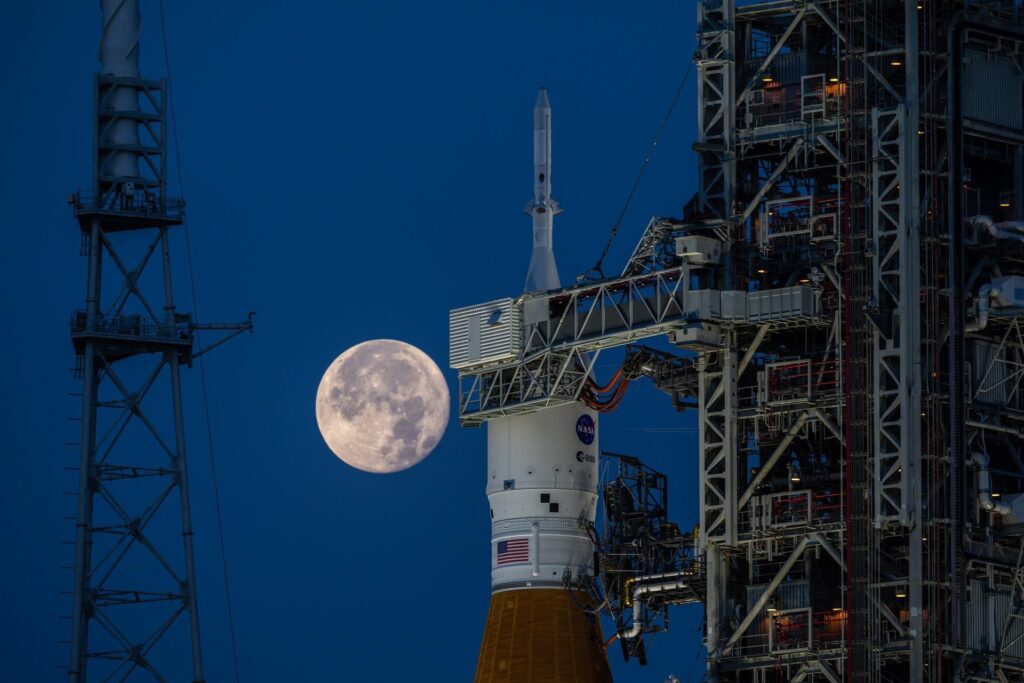
NASA has unveiled an ambitious three-part strategy to reshape America’s space leadership, focusing on returning astronauts to the Moon by 2028, establishing a long-term lunar base, and expanding commercial activity in low-Earth orbit.
Testifying before the House Science Committee, NASA Administrator Jared Isaacman said the plan aligns with the US national space policy and aims to accelerate progress amid growing global competition.
Table of Contents
Moon Return by 2028
The first priority is to land American astronauts on the Moon within the next four years. This goal is part of the broader Artemis programme, which seeks to return humans to the lunar surface for the first time since 1972.
Isaacman emphasized increasing launch frequency to maintain momentum and highlighted the success of Artemis II as proof that efficient execution can deliver impactful results.
“We showed the world the Moon again, and we showed humanity Earth again,” he said, calling it a milestone moment.
Building a Sustainable Lunar Base
Beyond short-term missions, NASA plans to establish a sustained human presence on the Moon. This includes developing essential infrastructure such as landers, rovers, power systems, and communication networks.
The agency intends to collaborate closely with private industry to build a “Moonbase,” marking a shift toward stronger public-private partnerships in space exploration.
Expanding Commercial Space Economy
The third pillar focuses on increasing commercial opportunities in low-Earth orbit. NASA aims to transition toward privately operated space stations and expand astronaut missions, payloads, and monetization prospects.
Under this approach, the agency will rely more on industry for routine operations such as satellite deployment and Earth observation, while focusing its own efforts on complex missions like deep-space exploration and nuclear propulsion systems.
Also Read:https://skylinktimes.in/rs-975-crore-defence-deal/
Budget Concerns and Political Debate
Despite the ambitious roadmap, lawmakers raised concerns over funding. The proposed budget includes a roughly 23 per cent reduction compared to the previous year, prompting fears about its impact on US competitiveness.
House Science Committee Chairman Brian Babin warned that underfunding NASA could weaken its position, particularly as China accelerates its lunar ambitions. Ranking Member Zoe Lofgren cautioned that the cuts could harm scientific and technological programmes.
A Shift in Strategy
Isaacman defended the strategy, arguing that NASA must move away from costly, inefficient programmes and instead focus on delivering measurable results. He stressed that stronger outcomes can be achieved by eliminating inefficiencies and prioritizing core objectives.
Founded in 1958, NASA has long been at the forefront of global space exploration, from the Apollo Moon landings to the International Space Station. Today, renewed geopolitical competition is driving a fresh push toward lunar missions and long-term human presence beyond Earth.
The Artemis programme remains central to this effort and is expected to serve as a stepping stone for future missions to Mars, as NASA works to maintain its leadership in the rapidly evolving space race.
For More Info Stay Tuned: https://skylinktimes.in