New Delhi| November 12, 2025 | SKY LINK TIMES
Delhi Smog Crisis :
Delhi woke up to another morning under a thick layer of toxic smog, as the Air Quality Index (AQI) remained in the ‘severe’ category for the third consecutive day. Visibility dropped sharply across several parts of the capital, leaving millions struggling to breathe clean air.
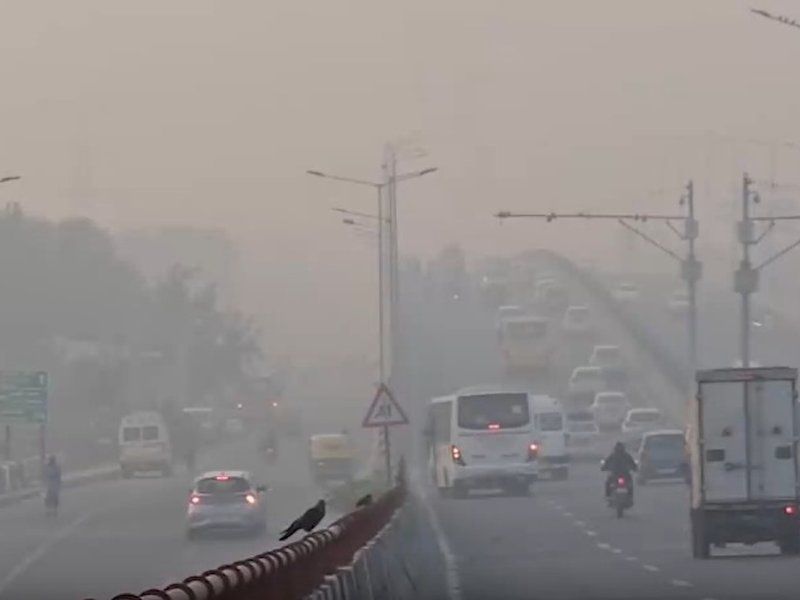
According to data from the Central Pollution Control Board (CPCB), major monitoring stations recorded AQI levels well above the hazardous mark of 400. The Geeta Colony–Laxmi Nagar area logged an AQI of 413, while India Gate and Kartavya Path recorded 408.
Table of Contents
In northern and western Delhi, pollution levels were even worse — Anand Vihar (438), Ashok Vihar (439), Chandni Chowk (449), Jahangirpuri (446), Rohini (442), and Dwarka Sector-8 (422) — all breaching the “severe” threshold. Experts have warned that exposure to such concentrations of particulate matter can cause serious respiratory and cardiovascular illnesses, especially among children and the elderly.
Delhi Government Shifts to Hybrid Classes for Young Students
In response to the deteriorating conditions, the Delhi government on Tuesday announced that students up to Class 5 would move to hybrid learning starting Wednesday. The step comes under Stage 3 of the Graded Response Action Plan (GRAP), which activates emergency measures when pollution reaches severe levels.
Chief Minister Rekha Gupta said, “Safety measures are being implemented swiftly under GRAP Phase-3. From Wednesday, classes up to Class 5 will be conducted online. Hybrid mode will remain in effect in schools.”
A circular from the Delhi Education Department directed all government, aided, and private schools under NDMC, MCD, and the Delhi Cantonment Board to switch immediately to hybrid learning “until further orders.”
Director of Education Vedita Reddy instructed all school heads to “inform parents and guardians at the earliest” regarding the updated arrangements.
Also Read:https://skylinktimes.in/pm-modi-bhutan-king-pray-to-lord-buddha-relics/
Centre Seeks Action Reports from NCR States
Meanwhile, Union Environment Minister Bhupender Yadav convened a review meeting to assess the situation in Delhi-NCR. He directed all states and union territories with administrative offices in the region to submit detailed action-taken reports on air pollution control measures.
Officials said these reports would help evaluate compliance with anti-pollution directives, including restrictions on construction, industrial operations, and vehicular emissions.
Public Health Emergency Looms
Environmental experts say stagnant wind patterns, post-harvest stubble burning in neighbouring states, and urban emissions have created a “gas chamber” effect over Delhi. The concentration of PM2.5 particles has exceeded the safe limit by seven to eight times, posing severe health risks.
Citizens are being urged to limit outdoor activity, wear N95 masks, and use air purifiers indoors. Doctors have reported a spike in cases of asthma, bronchitis, and eye irritation over the past week.
As Delhi continues to battle its annual pollution crisis, the big question remains — how long can the capital hold its breath?
For More Updates Stay Tuned:https://skylinktimes.in