Agartala | January 10 | SKY LINK TIMES
In a major boost to sustainable rural development in Tripura, three villages—Purba Badlabari, Purba Baichabari, and Rajnagar—located in the Tulashikhar block of Khowai district, have been included under the Bio-Village 2.0 project for the 2025–26 financial year. The inclusion follows the remarkable success of the state government’s flagship initiative implemented by the Department of Biotechnology.
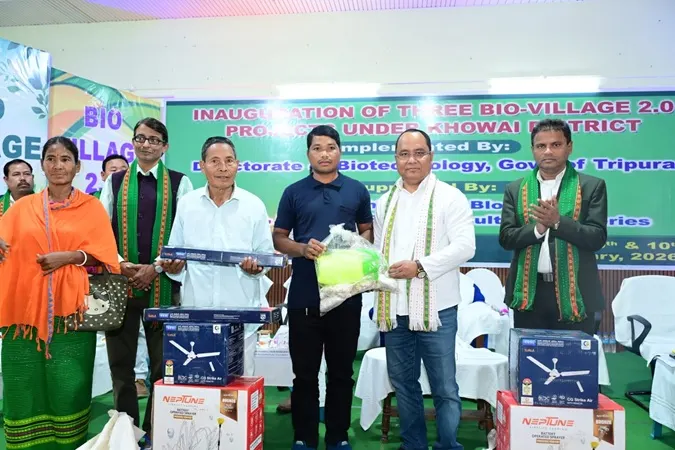
Speaking on the occasion, Anjan Sengupta, Joint Director of the Department of Biotechnology, said the project’s success had exceeded expectations. He recalled that ONGC Tripura first extended financial support to the Bio-Village initiative in 2018, followed by collaboration on multiple projects. Currently, the scheme is being implemented with financial assistance from the Tripura government, and the simultaneous launch of three Bio-Village 2.0 projects in tribal-dominated areas has set a new benchmark. So far, 31 Bio-Village 2.0 projects have been implemented across the state.
Benefits to Rural Households
Under the project, 210 beneficiaries from the three villages are receiving a range of environment-friendly and income-generating assets. These include energy-efficient LED bulbs, VLDC fans, street lights, solar-powered pumps, piglets with feed, ducklings, goat kids, mushroom cultivation materials, fish fingerlings, biogas plants, solar stoves, beekeeping equipment, chicks, and other livelihood inputs, based on individual choice and local resource availability.
A beneficiary from Purba Badlabari village, Ranveer Debbarma, said the project had brought “immense joy” to his life. He has already received LED bulbs, fans, and street lights and opted for pig farming and solar-based facilities under the scheme.
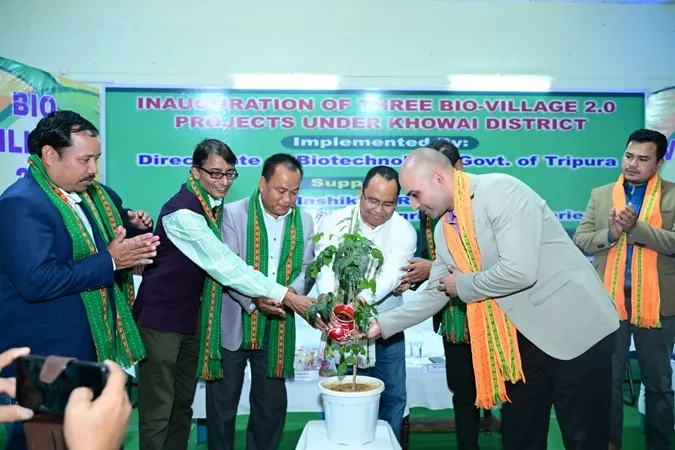
On January 10, 2026, the three new Bio-Village 2.0 projects were officially inaugurated at the Shiter Smriti Community Hall in Tulashikhar by Animesh Debbarma, Minister for Science, Technology and Environment. The initiative has also earned appreciation from NITI Aayog for its innovative and sustainable approach.
ALSO READ : 159 Farmers Receive Modern Farm Equipment Under SMAM Scheme
Community-Centric Development Model
Bimal Das, an official associated with the project, said the Bio-Village 2.0 initiative not only promotes economic self-reliance but also fosters community cooperation and collective growth.
The project is being implemented with the active support of the Tulashikhar RD Block, Departments of Animal Husbandry, Fisheries, Agriculture, Tripura Renewable Energy Development Agency (TREDA), and Energy Efficiency Services Limited (EESL).
Beneficiaries can choose 5–6 livelihood components from a list of 15–16 options, ensuring flexibility and alignment with local ecological conditions.
On the day of inauguration, 210 beneficiaries received 840 LED bulbs, 318 street lights, rechargeable bulbs, fans, 22 battery-operated 20-litre spray pumps, 330 litres of organic liquid fertilizer, and a one-time grant of ₹3,000 each.
Experts believe the Bio-Village 2.0 project will significantly enhance rural incomes, promote climate-resilient livelihoods, and strengthen the social and economic fabric of rural Tripura.
For More Info Stay Tuned: https://skylinktimes.in